Tuesday, November 7, 2017

Cervantes, as Kundera Sees It! Intro and Segment I

Thank you for the interest in joining the discussion on 
The Depreciated Legacy of Cervantes.
For the full text of Kundera's essay, click here.

This study is divided into FOUR segments. You are expected to spend at least 30 minutes on each segment. Further, you may have to attempt to prepare brief answers to some questions and submit them online.

The text of the essay is divided into 10 sections, and are to be made available as a separate file. 
Segment 1
This contains
  • an introduction to the essay
  • Text of Sections 1 and 2
  • Brief explanations of Sections 1 and 2
  • Questions for discussion

Introduction

Milan Kundera (born 1 April 1929) is a Czech-born writer who has been living in exile in France since 1975. His best-known work is “The Unbearable Lightness of Being”.
“The Art of the Novel” is a short collection, mainly of essays, which have been published individually. Divided into seven chapters, the book appears to be fragmented because of the different forms (essay, dialogue, public address, and dictionary entries) employed and the disjointed style that resulted from the pieces being written over a period of several years and published in various journals and newspapers. Kundera insists, however, that the sections were conceived of as a book. As one reads, certain themes and ideas recur and complement one another. Thus, although initially the chapters seem unrelated in form and content, a whole emerges.
The first essay, "The Depreciated Legacy of Cervantes," was earlier published in 1984 in The New York Review of Books under the title "The Novel and Europe." The essay, which outlines the history of the European novel, is divided into 10 sections.
Text: Sections 1 & 2
1.
 In 1935, three years before his death, Edmund Husserl gave his celebrated lectures in Vienna and Prague on the crisis of European humanity. For Husserl, the adjective “European” meant the spiritual identity that extends beyond geographical Europe (to America, for instance) and that was born with ancient Greek philosophy. In his view, this philosophy, for the first time in History, apprehended the world (the world as a whole) as a question to be answered. It interrogated the world not in order to satisfy this or that practical need but because “the passion to know had seized mankind.”
 The crisis Husserl spoke of seemed to him so profound that he wondered whether Europe was still able to survive it. The roots of the crisis lay for him at the beginning of the Modern Era, in Galileo and Descartes, in the one-sided nature of the European sciences, which reduced the world to a mere object of technical and mathematical investigation and put the concrete world of life, die Lebenswelt as he called it, beyond their horizon.
 The rise of the sciences propelled man into the tunnels of the specialized disciplines. The more he advanced in knowledge, the less clearly could he see either the world as a whole or his own self, and he plunged further into what Husserl’s pupil Heidegger called, in a beautiful and almost magical phrase, “the forgetting of being.”
 Once elevated by Descartes to “master and proprietor of nature,” man has now become a mere thing to the forces (of technology, of politics, of history) that bypass him, surpass him, possess him. To those forces, man’s concrete being, his “world of life” (die Lebenswelt), has neither value nor interest: it is eclipsed, forgotten from the start.
 2.
 Yet I think it would be naive to take the severity of this view of the Modern Era as a mere condemnation. I would say rather that the two great philosophers laid bare the ambiguity of this epoch, which is decline and progress at the same time and which, like all that is human, carries the seed of its end in its beginning. To my mind, this ambiguity does not diminish the last four centuries of European culture, to which I feel all the more attached as I am not a philosopher but a novelist. Indeed, for me, the founder of the Modern Era is not only Descartes but also Cervantes.
 Perhaps it is Cervantes whom the two phenomenologists neglected to take into consideration in their judgment of the Modern Era. By that I mean: If it is true that philosophy and science have forgotten about man’s being, it emerges all the more plainly that with Cervantes a great European art took shape that is nothing other than the investigation of this forgotten being.
 Indeed, all the great existential themes Heidegger analyzes in Being and Time—considering them to have been neglected by all earlier European philosophy— had been unveiled, displayed, illuminated by four centuries of the novel (four centuries of European reincarnation of the novel). In its own way, through its own logic, the novel discovered the various dimensions of existence one by one: with Cervantes and his contemporaries, it inquires into the nature of adventure; with Richardson, it begins to examine “what happens inside,” to unmask the secret life of the feelings; with Balzac, it discovers man’s rootedness in history; with Flaubert, it explores the terra previously incognita of the everyday; with Tolstoy, it focuses on the intrusion of the irrational in human behavior and decisions. It probes time: the elusive past with Proust, the elusive present with Joyce. With Thomas Mann, it examines the role of the myths from the remote past that control our present actions. Et cetera, et cetera.
The novel has accompanied man uninterruptedly and faithfully since the beginning of the Modern Era. It was then that the “passion to know,” which Husserl considered the essence of European spirituality, seized the novel and led it to scrutinize man’s concrete life and protect it against “the forgetting of being”; to hold “the world of life” under a permanent light. That is the sense in which I understand and share Hermann Broch’s insistence in repeating: The sole raison d'etre of a novel is to discover what only the novel can discover. A novel that does not discover a hitherto unknown segment of existence is immoral. Knowledge is the novel’s only morality.
 I would also add: The novel is Europe’s creation; its discoveries, though made in various languages, belong to the whole of Europe. The sequence of discoveries (not the sum of what was written) is what constitutes the history of the European novel. It is only in such a supranational context that the value of a work (that is to say, the import of its discovery) can be fully seen and understood.
Brief Explanations - Sections 1 & 2
The flow of ideas:
Husserl (German philosopher) and his views of the crisis of European humanity – Reference to Galileo and Descartes – Heidegger (pupil of Husserl) and his reflections on Husserl’s idea of “the world of life” (dei lebenswell) – Heidegger’s idea on “the forgetting of being” – the relevance of Cervantes and the novels.
1. Kundera starts his essay with a reference to the lectures by the German philosopher Edmund Husserl (1859 – 1938) in Vienna and Prague, on the crisis of European humanity. For Hesserl, ‘Europe’ was a spiritual identity which goes beyond geographical Europe (to America, for instance). Such an idea that apprehended the world as a whole came from ancient Greek philosophy. This philosophy interrogated the world not in order to satisfy this or that practical need but because of a passion to know.
For Husserl, the roots of the crisis lay at the beginning of the modern era, in Galileo and Descartes: the one-sided nature of the European sciences reduced the world to a mere object of technical and mathematical investigation. The concrete world of life – dei lebenswell – was beyond their horizon. The rise of sciences turned man into tunnels of specialized disciplines. With advancement in knowledge, he failed to see the world as a whole, or his own self. Husserl’s pupil Heidegger (1889 – 1976) calls this ‘the forgetting of being’.
Though Descartes once called man as “master and proprietor of nature”, man has now become a mere thing to the forces of technology, politics or history that bypass him, surpass him or possess him. To these forces, man’s world of life has no value.
2. The two philosophers Galileo and Descartes laid bare the ambiguity of this epoch, which is decline and progress at the same time. This ambiguity does not diminish the last four centuries of European culture. Among the founders of the modern era, Kundera considers another name: Cervantes.
Galileo- 1554- 1642; Descartes- 1596 -1650; Cervantes- 1547-1616
Philosophy (Descartes) and science (Galileo) have forgotten about man’s being. With Cervantes, a great European art took shape – the investigation of this forgotten being. In his work Being and Time, Heidegger presents some existential themes which he considers to have been neglected by all earlier European philosophy. These themes have been unveiled, displayed and illuminated by four centuries of the novel: “In its own way, through its own logic, the novel discovered the various dimensions of existence one by one: …”
With Cervantes and his contemporaries (16th century), the novel enquires the nature of adventure.
With Richardson, (17th century), the novel enquires “what happens inside”… to unmask the secret life of the feelings
With Balzac, (19th century), the novel enquires man’s rootedness in history
With Flaubert, (19th century), the novel enquires the _terrain_ previously _incognita_ of the everyday
With Tolstoy, (16th century), the novel enquires intrusion of the irrational in human behavior and decisions.
With Proust, (19th century), the novel enquires of TIME – the elusive past
With Joyce, (19th/ 20th centuries), the novel enquires of TIME – the elusive present
With Thomas Mann, (20th century), the novel enquires the role of myths from the remote past that control our present actions
The novel has accompanied man since the beginning of the Modern Era, with the ‘passion to know’ (Hesserl). It has been scrutinizing life and protecting it against ‘the forgetting of being’ to hold ‘the world of life’ under a permanent light. Kundera takes an idea from the Austrian writer Hermann Broch and says: “the sole purpose of existence (raison d’etre) of the novel is to discover what only the novel can discover”.
The novel is Europe’s creation. Its discoveries belong to Europe. This sequence of discoveries constitutes the history of the European novel. 

Thursday, December 18, 2014

archaeologist

A Day with the Archaeologist

If anyone loves a career to be in ruins, that is an archaeologist.
  
At Smitha's office (ASI, Bijapur)
I was on a visit to Bijapur, where my student Smitha S Kumar works as an archaeologist. During my five days of stay there, we roamed around the archaeological sites of Bijapur, Hampi and Badami. But the best was kept for the last - That was when Smitha took me for what is called a “village to village survey”.

As an officer of the Archaeological Survey of India, Smitha’s responsibilities include visits to remote villages in the area, to seek possibilities of hidden history. Not a search for spectacular monuments or startling discoveries, these surveys are quests to find out how the magnificent findings of the area relate to the surroundings and society of the bygone days. Monuments speak of the culture or religion of a ruler or a dynasty. But the archaeologist’s burden is also to find more on the social life of the times. One possibility of exploration is the village to village survey.

Smitha points out to Monesh the village from her map
With a target of around 20 villages to be surveyed every month, Smitha sets out with a topographical map of a segment of the land. A village is identified. The map, which itself is a bit old, may give but little clue on what to expect. Online resources such as Google Map can be of better help. So, we are off to the village of Atharga. With a local guide Monesh who doubles up as her pilot on his motor bike, Smitha sets off. Sangeet ( who assists Smitha with photo documentation)  and I follow on another bike.

Monish, collecting information from the village folk
 Monesh is irreplaceable! He has a knack of finding directions, interacting with locals in their language, and getting ideas across as and when needed. 


Bijapur’s history and archaeology has the Adil Shahi dynasty (15th and 16th centuries) as its central focus. A period known for its architectural marvels such as the Golgumbaz, the reign is no less significant for the contributions given to the administration and welfare of the masses. If this is true, can there be evidences even now? Do the villages have anything to say or show on this, left to be discovered or identified? That is the quest of the archaeologist.

At a structure that can possibly be a bastion of the Adil Shahi period
Usual questions and queries direct Smitha to a spot. Nothing impressive there: just a mound, which appears as nothing more than piled up remains of a wall or something. But, says Smitha, this can be, in all possibility, the ruins of a bastion. Almost all villages had a fortification around them, with bastions at their corners. Nothing to be finalized or established, Smitha’s role here is just to record and report. She takes bearings of the location on her GPS, and establishes directions and landmarks. All entries are made into her file, for a systematic documentation later.
As the GPS comes to help...

Information from a village gentleman
The elderly person who offered information directed Smitha to another location. A temple, which is supposed to be very old. Usually the villagers are friendly and helpful, as I gather. But some are wary. For, there is the natural fear that if a place that is part of some private property is noted as an archaeological finding, the present owner will stand to lose it. So, the archaeologist has to use tact and patience to get all possible information. She has to be part of them, give them the needed reassurance that this survey is just for purposes of documentation.

By the time we reach the temple, some children are with us. They are everywhere, says Smitha. Very often, they are of immense help. Keen to assist and offer information, their sincerity often helps the surveyor to find more. At the temple, they rush to get the keys to enter the backyard. They offer suggestions on what can be expected.
The boys got us the keys!
We enter the temple. Nothing extraordinary to the common eye. But Smitha points me to the roof. “See the interlaced arches on the dome. That is definitely an Adil Shahi architecture.”
Interlaced arches inside the temple dome
I recollect what I had seen at the great monuments of Bijapur. So that means, this local temple dates back to the 16th century? Glad that I witness a small yet significant finding that may go into the records of Indian archaeology.


Smitha and Sangeet at the bawdi
We hit the road once again. Back home? Not yet. As we travel back, Smitha signals us to stop, in the middle of nowhere. See the difference in vegetation?- She asks us. Yes, there is a lush growth and more abundance of greenery at the point she indicated. “Every possibility for a bawdi ..."  
I wonder. She had taken me to bawdies the other day. They are water bodies – wells or tanks – of the Adil Shahi period. Structures that assured people with provision of enough water for the home and the farm. Even in a bawdi, you can see features of the Adil Shahi architecture. Usually, elaborate, ornamental structures and carvings surround them. But what is it here in a village? Smitha explains: every village will have a number of bawdies, carefully constructed and properly maintained. Here, if you observe the vegetation, we may wisely guess the presence of a baudi. She was right. There was a wide and deep well with clear water at that point. Now used by local farmers to draw water using electric pumps. How can we trace its history?
Looking around, the archeaologist’s eyes gleam. She points us to two pieces of cut stone lying around. They have a square hole near one end. These are water-lifting mechanisms. Clearly a feature of the Adil Shahi period.
He was happy we visited his land
The land belongs to a farmer, who lives nearby. He is not at all worried about the discovery. His wife joins him, and they offer us water. Staying back for tea?- they ask us. But we know it won’t be good to trouble them for that. 

Woes of a villager, shared to the archaeologist!
We move on. Yet another farm. The owner shares his agony about the disinterestedness from the part of the government. Smitha, for him, is a representative of the Government, and so he has the right to tell her of his woes, he feels! And he is happy to help the madamsaab with answers to her questions on the types of crops in his land, and features of topography.

More bawdies to be discovered. Some appear to be of a more recent construction, and some defy dating. But Smitha is not worried. At least, listen to the sparrows chirping from inside, she asks us. For, that is a feature beyond recorded history: every bawdi will be rich with nests of sparrows, unless and until the modern day man decides to provoke them beyond tolerance.

The day’s work over for us, but not for Smitha. She takes us for lunch to her favorite wayside shack. Even while eating, one can sense her mind wandering… on the findings of the day, and on the discoveries that wait. Yes, that is just one day of the archaeologist… a day when she plays many roles: a historian, a geologist, an agriculturalist, a geographer … and a human being with concern and care.


Smitha S Kumar, Assistant Archeologist at ASI Bijapur, is an alumna of CMS College, Kottayam, where she was the blogger’s student for her undergraduation in English Language and Literature. Later, she did her post graduation at the University of Kerala. Currently she pursues her Ph D in Archaeology at the University of Baroda, on the topic "The Role of Buddhism in the Development of Urban Centres in Maldives Islands". 

Sunday, February 26, 2012

Of Travels and Tastes

Travel plans often come with warnings as to what not to eat and drink. But still, one has to eat while traveling. It’s a situation of being able to choose as well as not being a
ble to choose. You can choose your dishes – south or north, veg or non-veg. But, the sorry fact
is that you can’t choose and pick much of homemade, simple food. Now you get my idea of a traveler’s luxury?
The start of 2012 was celebration time for us. Ashish’s (Anu’s brother) marriage to Sneha on 26 January triggered off a series of celebrations; that meant, we had a wonderful chance to travel… and to eat!

Jecko, Ashish, Anu & Steve
Naturally, wedding receptions mean good food. We are glad that the food served for the reception was good: bread rolls with fish molee, and vegetable pulao with chicken. Ice cream with fruits as desserts.

And then, to travel! Four destinations, with four-score and more dishes to test and taste.

BANGALORE

Sneha's House in Doddanakally, Bangalore

Sneha’s family, with roots in Kerala, is now settled in Bangalore.

Ashish & Sneha with her parents Mr. T P Joseph & Mrs. Gracy Joseph, and her brother Swaroop

There was a reception at Bangalore, in honor of the newlyweds. So, our first halt was there. Staying with Jinu (Anu’s cousin) and Relly was fun; equally enjoyable was the time the three kids Jeevan, Johan and Steve could have. Relly surprised us with waffles: American food, she says. Just for that, I love America!

For Steve, the highlight was KFC!

L-R: Steve, Sneha, Ashish, Johan and Jeevan


PUNE

GoAir took us to Pune. Just an hour's flight... and our destination is a Seminary. Aren't these good excuses to be on a fast?!

Jecko, Steve and Anu at UBS: The sculpture in the back depicts Jesus washing Peter's feet, a reminder of servant leadership.


Invitations to Pune have been around us for long, but it was Shalu’s privilege (or pain!) to host us. Shalu T Mathew, currently a final year student of Theology at Union Biblical Seminary, had been Anne’s student at Bishop Moore College, Mavelikara. Shalu always wanted us to come to Pune. Now, with just a few weeks before his graduation, we had to crash in, for that was a promise.

Shalu’s treat at Pune started at Krishna Gardens, with one of my favorites: hot rotis baked in the oven, with vegetables. Salted lassi to go with it.

Shalu & Alfred
Life in the Seminary was relaxing for us. Old bonds to be strengthened – Amrith and Reshma (chappatis, made for us as per special request), Reji and Bindu (with Kerala Palappam and excellent rajma curry), my student Anuroop, the newly married Rajani with her husband Renju, and many more! And, there were new friendships made, such as with Shalu’s friends Alfred and Amol who took us around Pune.


Sharon & Anu: Japanese Garden

Sharon (Anu’s cousin) is a postgrad student at Symbiosis School of Law. She joined us for a day’s outing, and we all roamed round Pune. That involved eating at a really good joint – “George”, as it is called: tasty biriyanis, nans, pulao and the like! Shivaji’s fort was history. Japanese Garden was culture. And the eating places just yummy!

Anu, Steve, Jecko & Sharon at the Shivaji Fort, Pune

The second day, we joined the seminarians for lunch: beef biriyani, prepared for around 200 hungry stomachs. It’s all unbiblical: after they had finished, very little was there to be collected in baskets. But the joy and fun overflows. We sat around the table with friends old and new: all from Kerala. Jokes, banters, humorous stories of unrequited love affairs, interests expressed and rejected… all flew across the table. A birthday too was celebrated, and the birthday baby was coaxed into buying ice creams for all of us round the table!

The Two Gandhis

The afternoon was again for roaming around Pune. The Samadhi of Kasturba Gandhi tells us a story with a moral: an activist is not an island. Gandhiji’s involvement and sacrifice in the freedom struggle was strengthened by that saintly woman who was at his side from near childhood.

Steve and Jecko at the Kasturba Samadhi

Now for a merrier note: Sarah, my student for MA in CMS College, Kottayam, is nicknamed ‘Gandhi’ for her truthfulness and honesty. As a family, we were with this batch for a tour, years back (Steve was just 3 years old then.) We came to know that Sarah is in Pune. We felt that a visit would be nice!

with Sarah

SURAT

Signs of misbehavior from the stomach made us a bit careful. Supper was limited to fruits. For, it was an all-night travel by road from Pune to Surat. To see us off, there was indeed a big bunch from UBS. That is love… a sincere and unpremeditated practice of what they learn from the Bible.

It was our first experience travelling in a sleeper coach by road – and that too, a double decked one! After about an hour’s weaving through various pick-up points in Pune, the bus hit the highway, and it was a smooth ride for about 10 hours to Surat.

Why Surat? Again, bonds of love, of friendship. Moni (Mr. Scaria John, Pulinjumootil) from Mallappally and I share a special bond of friendship, developed mainly through the CSI Choir, Mallappally.

The ol' Paachuvum Kovaalanum: Jecko & Moni

Moni and Sherly always wanted us to visit them. The two days with them and their children Merin and Mebin just went off, making all of us feel that more time was needed. Visits to the Planetarium, malls, industrial belts, and homes of some friends, or just a drive through the clean and spacious roads- Surat fascinated us.

Moni, Sherly, Merin & Mebin enjoying at the Mall

No need to talk of food! Sherly and Moni just pampered us and coaxed us to eat more. And Sherly proved that the food that tastes best can be simply simple.

Merin, Mebin, Steve

Renji, a student of Anne, now works in Surat. He joined us on a visit to the mall. Renji was keen that he should entertain us with a meal. So once again we could have those good nans, rotis and north Indian rice preparations.

We’ve always wanted to travel by Rajadhani Express. So, it was that from Surat to Delhi. Honestly, we didn’t enjoy it much! Was it coz we expected much? The complementary breakfast was fresh and tasty: the three of us took omlette with bread.

It was common practice, but I felt it funny: after we had finished eating, and the plates got cleared, one of the waiters approached the passengers with a plate of sweetened cumins (jeera): a popular practice in India. These cumins give a fresh feeling to the mouth. A hundred rupee note lay on top. Surely, this was placed by the guy! The message was clear: you may drop in some money as tip. Can be Rs. 100, or even more? The passengers knew better… purses were opened, and what came out were tens or twenties.

DELHI

Once again to Delhi. It is indeed “new” Delhi for us- it’s now the place where Ashish works. We are now visiting a place where we have the family of our brother and sister. And, this visit helped us to be part of other families as well…!

Sneha's first visit to Ashish's office

Emmanuel Hospital Association, where Ashish works as Finance Officer, had to celebrate the marriage of their colleague. Sneha’s parents joined us there, and we all took part in the party arranged there. Again, pulao, but with different side preparations: paneer, fish and chicken. The next evening, it was the turn of Bethel CSI Malayalam Church at Vikaspuri to celebrate.

Sam Mathew Achen leading the Service

My dear friend Rev. Sam Mathew Kavunkal now ministers there. He has the midas touch of changing functions into festivals, and we all had a wonderful time there. Pratheesh achen came all the way from Dehradun. There was another student of our first batch, now an ordained priest, Rev. John Mathai who gave the sermon.

. The same caterer who served the previous day gave us fried rice and chicken; on both occasions, the food was fresh, tasty and enjoyable

Piyush, Jecko, Steve, Ashish, Sneha, Biju, Pranav, Elsie and Anu

Stay in Delhi was great, especially as we were with Biju and Elsie. Biju (Mr. Abraham P Kurian) hails from Mallappally, and is the senior colleague of Ashish.Surprisingly, Elsie and Anu are similar in many ways, also in their love for mutton biriyani and peanut butter too! With Biju and Elsie and their two sons Piyush and Pranav, moments of fun and enjoyment went unmeasured. Steve once again had his ‘mall visits’, with his two new friends. And, one more KFC!

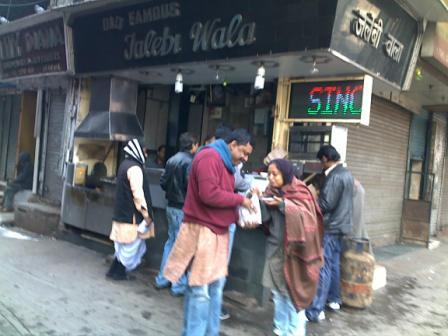
The ‘Delhi Darsan’ as Biju calls it, was an early morning drive through the city. Rastrapati Bhavan, Parliament Houses, Qutab Minar, India Gate… but what fascinated me most was Chandni Chowk… especially its Jalebi Walla!

This shop boasts of a tradition of 142 years. Golden brown jalebis, fresh and crisp, scooped out from the huge frying pans… a temptation too hard to resist! Our day started with jalebis instead of tea!

The jalebis dipped in sugary syrup were made out of fresh ghee which made it edible for our stomach in the wee hours of the morning. As their custom was, the father made the first jalebi, made it an offering to the gods, then handed over the day’s business to his son. While we chatted with him, the old man was proud to say that his shop was more than a century old and he also said that malayalees were good people, contrary to what we mallus ourselves believe!

As if to take us to a different side of the Delhi taste, Biju’s next halt was at a ‘chola puri’ stall. A small cart and two men, but it was brisk business. We had to wait for some time till we could place our order. It was tasty; but more to it, the people were courteous, willing to come to the parked car more than once to serve the fresh stuff on leaves and paper, truly ‘dilhi’ style!

On Sunday afternoon, with Sneha’s parents, we all went out to eat after church. This time, it was a Chinese hotel, which served Indian food as well. Not brave enough to try Chinese, we remained patriotic. The soup was very delicious….

Delhi was slowly coming out of its winter. Such a change of season often means health problems. It seems that we too were getting affected. But, we held on, and God was kind enough to let us be so.

Home’s the best. And so, Elsie and Biju did it. That marked our grand finale of the wedding season: the dinner at their place: the Kerala colors of kappa (tapioca), fish curry and chicken roast. Who can resist?

Indigo, in their in-flight leaflet, advertises some chocolate cookies, in an attractive reusable cookie tin. We bought one. It was beautiful outside, and tasty inside. We enjoyed it on our Delhi-Nedumbassery flight: our dessert of the wedding season.

Travelling means eating out. Though there are risks involved – indigestion and tummy aches – it is worth a try. For, then only can we really enjoy what is often called, ‘the taste of India’.

From waffles and jalebis to kappa and meen curry, our travel was truly tasty!